
Improve inside the loop
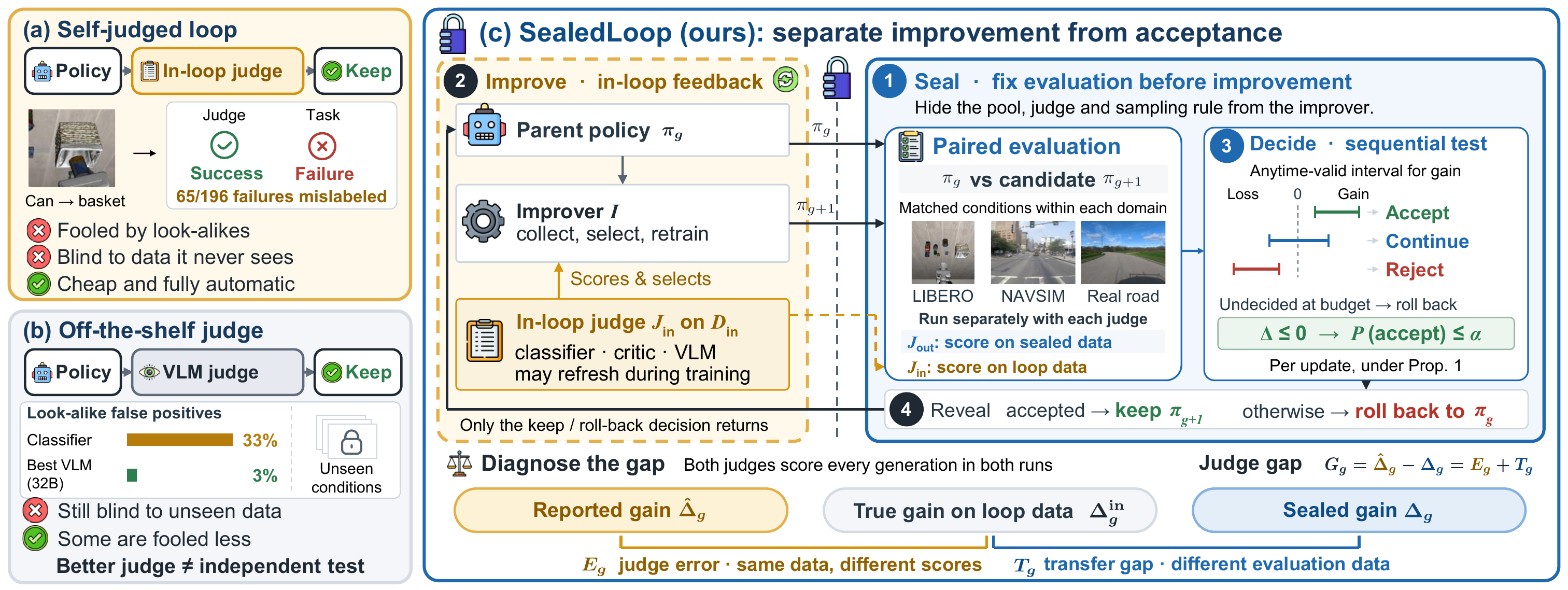
The policy collects experience and is retrained with the loop's own judge, exactly as before.
University of Wisconsin–MadisonUniversity of California, Santa Cruz
Corresponding author: sikai.chen@wisc.edu
REAL-WORLD FIELD EXPERIMENT
01 / THE PROBLEM
Self-improvement is now a practical recipe for embodied policies: a policy collects experience, is retrained, and is kept when a judge rates it higher.
The judge is usually trained or chosen inside the same loop, so its evidence is not independent of the policy. Running the same loop under each judge, we separate two sources of a false gain: judge error (the loop's judge is wrong on its own data) and transfer gap (a real gain there does not carry over to unseen conditions).
We introduce SealedLoop, an evaluation framework that adds a sealed judge: an evaluator outside the loop that the improver cannot see or optimize against.
Progress is judged by evidence the improving system cannot influence.
02 / THE APPROACH
 View figure
The policy collects experience and is retrained with the loop's own judge, exactly as before.
The keep-or-roll-back decision moves to a judge outside the loop, which the improver can neither see nor optimize against.
A new policy is kept only when a sequential test on the sealed judge confirms the gain, with a bounded probability of keeping a worse one.
03 / THE EVIDENCE
In manipulation, a success classifier trained inside the loop accepted 65 of 196 failures in one generation.
The video shows three evaluation episodes of one candidate policy. In both failures the can ends at the edge of the basket, still in the gripper, and the classifier labels all three episodes a success.
Manipulation
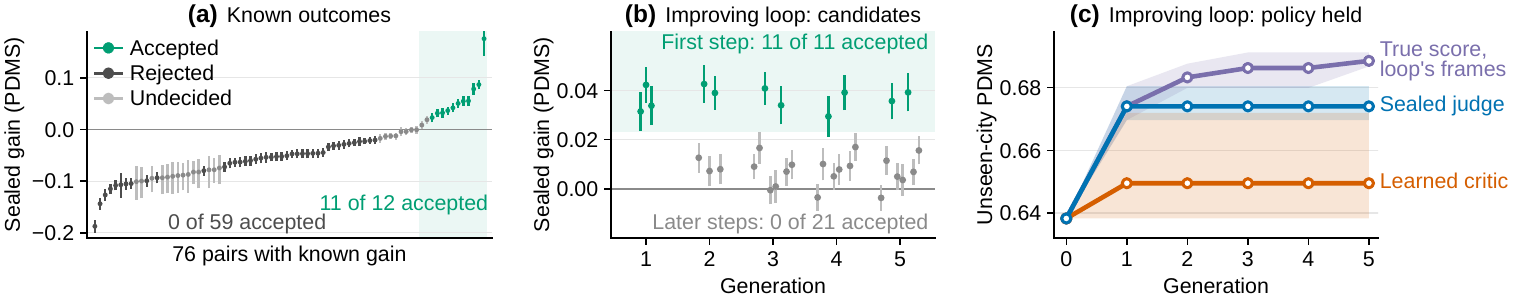
Video coming soonIn driving, policies that gain on the loop's own frames lose in an unseen city, so even an exact in-loop judge would keep 8 of 15 of them.

On driving pairs with known sealed gain, the test accepted 11 of 12 real gains and none of 59 losses.
When the sealed test decides, a driving loop built to improve ends with a better policy than under its own critic: 0.674 against 0.649 PDMS, from 0.638.
On a published improvement step, the reinforced version (RL) drove further into a curve than the imitation version it started from (IL) in all 6 blind pairs, by 10.4 m on average. Neither version completed the curve.
Field experiment
Video coming soon04 / VIDEO
Safety driver took over at 43 m (IL) and 55 m (RL) of the 144.4 m route.
Vehicle videos: the imitation version (IL, blue) on the left and the reinforced version (RL, orange) on the right, both from the front camera, aligned at the moment the automated driving mode was engaged. The colored line is the trajectory planned over the next 4 s and the white line is the route. A drive ends at the first intervention of the safety driver or at the end of the route; its panel then freezes and dims. All videos play at real time.
IN THE AUTHORS’ WORDS
Self-improvement is now a practical recipe for embodied policies: a policy collects experience, is retrained, and is kept when a judge rates it higher. However, the judge is usually trained or chosen inside the same loop, so its evidence is not independent of the policy. We introduce SealedLoop, an evaluation framework that adds a sealed judge: an evaluator outside the loop that the improver cannot see or optimize against. A new policy is kept only when a sequential test on the sealed judge confirms the gain, with a bounded probability of keeping a worse one. Running the same loop under each judge, we separate two sources of a false gain, which we call judge error (the loop’s judge is wrong on its own data) and transfer gap (a real gain there does not carry over to unseen conditions). We evaluate on LIBERO manipulation, NAVSIM driving, and a full-scale real vehicle. In manipulation, a success classifier accepted 65 of 196 failures in one generation. In driving, policies that gain on the loop’s own frames lose in an unseen city, so even an exact in-loop judge would keep 8/15 of them. When the sealed test decides, a driving loop built to improve ends with a better policy than under its own critic (0.674 against 0.649 PDMS, from 0.638), and on driving pairs with known sealed gain the test accepted 11 of 12 real gains and none of 59 losses. In a real-world field experiment on a published improvement step, the reinforced version drove further into a curve than the version it started from in all 6 blind pairs, though neither completed it. These results show that evidence from inside the loop, however accurate, is not enough to decide whether a policy has improved. SealedLoop offers a foundation for trustworthy self-improvement of embodied policies, in which progress is judged by evidence the improving system cannot influence.
05 / BUILD ON THIS WORK
@article{huang2026sealedloop,
  title = {Keep or Roll Back? Out-of-Loop Judges for Self-Improving VLA and End-to-End Embodied Policies},
  author = {Huang, Zilin and Wan, Zhengyang and Qian, Kangan and Sheng, Zihao and Chen, Sikai},
  year = {2026},
  journal = {arXiv preprint},
  url = {https://zilin-huang.github.io/SealedLoop/}
}