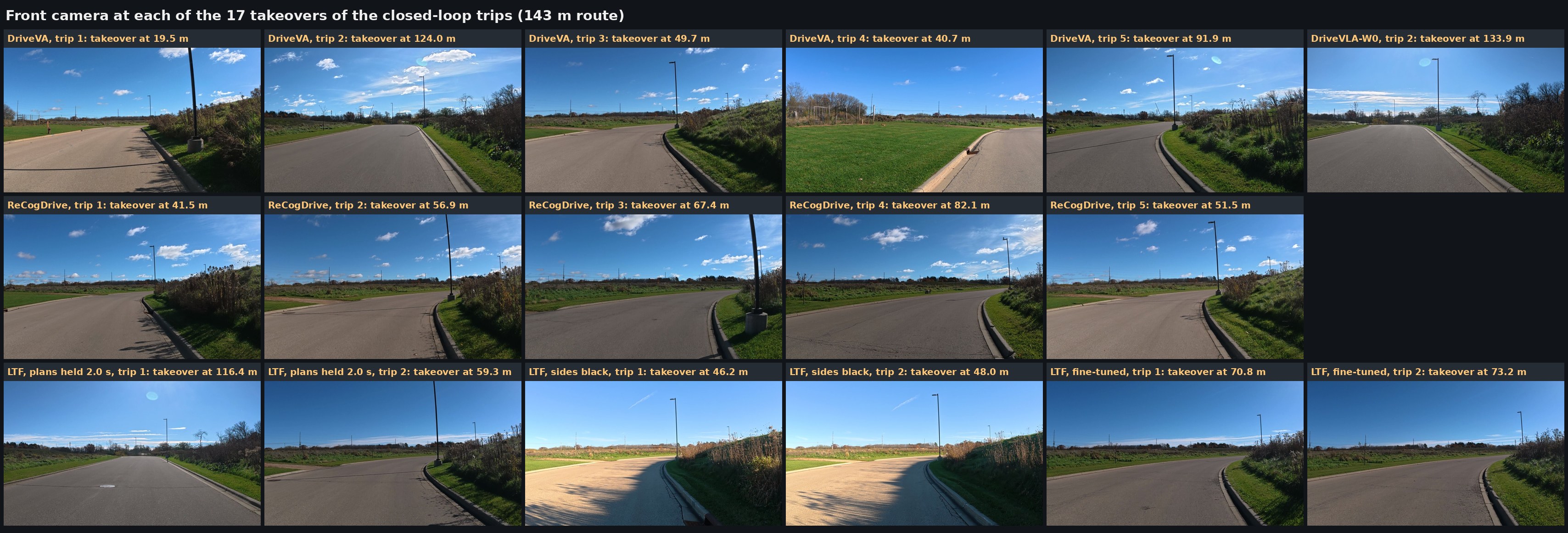
DriveVLA-W0, selected by Stage 4, front viewREACHES THE ENDDriveVLA-W0, its one takeover in five tripsTAKEOVER AT 133.9 MLTF, the challenger, three viewsREACHES THE ENDLatent-WAM, passes both gates, three viewsREACHES THE ENDDriveVA, highest benchmark score, fails the latency gateTAKEOVER AT 91.9 MReCogDrive, fails the latency gateTAKEOVER AT 51.5 MLTF, each finished plan held 2.0 s longerTAKEOVER AT 59.3 MLTF, two side views blacked outTAKEOVER AT 46.2 MLTF, fine-tuned on local recordingsTAKEOVER AT 70.8 M
01 / THE PROBLEM
The top-ranked checkpoint may not run on your platform.
Teams that cannot train a foundation model pick a public checkpoint by benchmark rank and fine-tune it on local data. The platform is fixed first: its sensors, onboard compute and site come with the task.
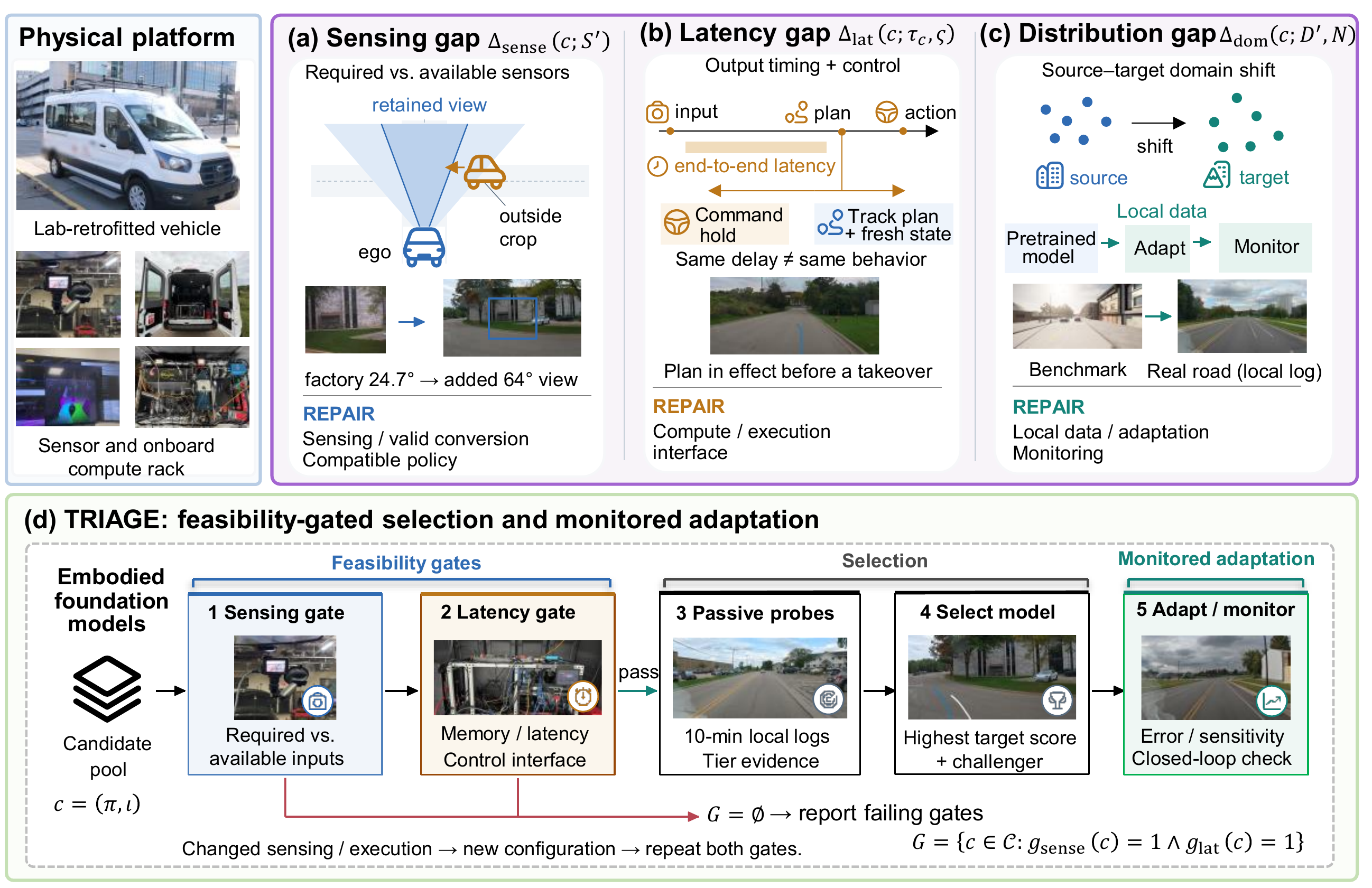
We split what a checkpoint loses on a fixed platform by what can repair it. A sensing gap is information the sensors do not capture; no amount of their data closes it. A latency gap is output that arrives after the control loop needs it; it belongs to the loop, not the weights. Only a distribution gap is fine-tuning’s to repair.
TRIAGE turns this split into a five-stage procedure: two gates that no score overrides, a ranking among the candidates that pass, and fine-tuning that is monitored and checked in closed loop before release.
↳
Find out before buying data or hardware whether a checkpoint can run on the vehicle or robot you own, and what to fix if not.
02 / THE APPROACH
Gate first. Rank second. Fine-tune under watch.
View figure ↗FIGURE 1 The repairability principle and the five stages: gates (1–2), selection (3–4), monitored adaptation (5).
01
Gate on sensing and latency
Stage 1 checks the model’s sensor contract against the platform’s cameras. Stage 2 checks the end-to-end latency at the 95th percentile, measured on the deployment hardware, against the control deadline. A failing gate names the repair it calls for.
02
Probe, then rank
Stage 3 runs probes on ten minutes of local logs. Stage 4 ranks the candidates that pass both gates by target-relevant benchmark score and keeps the runner-up as challenger.
03
Adapt under monitoring
Stage 5 fine-tunes on local data while monitoring the robustness it can cost, and releases a model only after a closed-loop check.
03 / THE EVIDENCE
The gates’ verdicts held in closed loop.
STAGE 2 / END-TO-END LATENCY
The highest scores arrive too late.
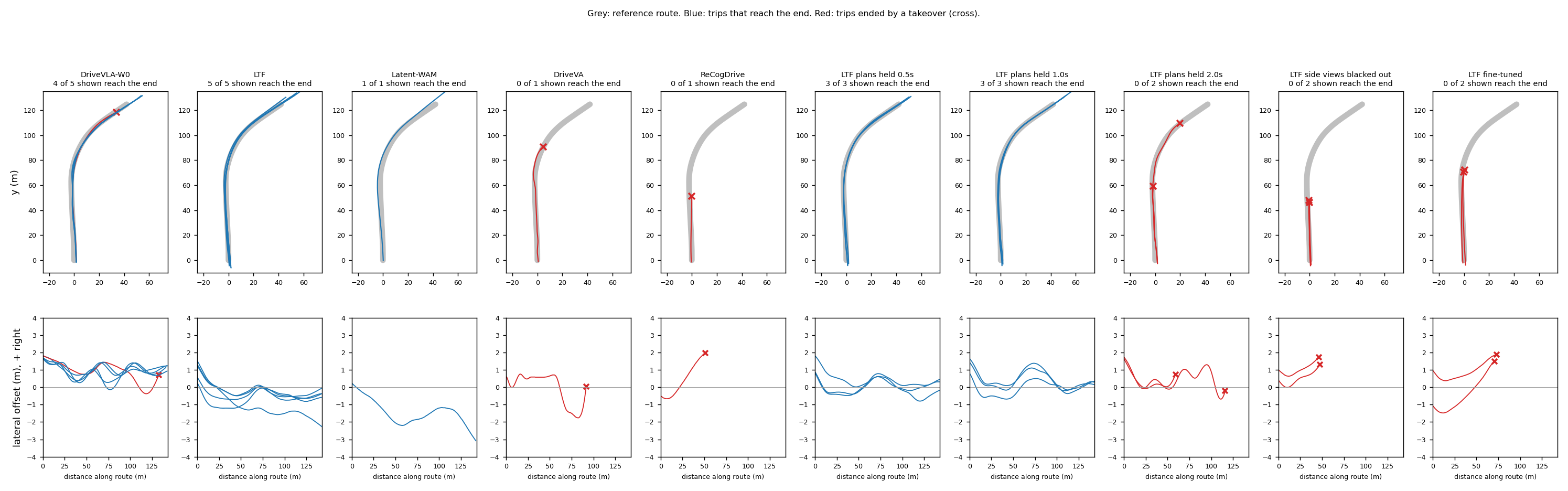
Five of six candidates meet the 1.2 s deadline on inference time; only three meet it end to end on the vehicle. The two highest-scoring candidates, DriveVA and ReCogDrive, do not, and neither completed a closed-loop trip.
DriveVA’s end-to-end latency was 1.580 s at the 95th percentile, over the deadline on every plan.
DriveVA
0/5
ReCogDrive
0/5
LTF
5/5
Latent-WAM
5/5
On Bench2Drive, a deadline below a leading closed-loop model’s latency makes it collide on 80 to 90% of routes.
▶
DriveVA closed-loop trip
Video coming soon
STAGE 1 / SENSOR CONTRACT
Field of view is gated. Resolution is not.
At equal pixels, losing field of view moves plans 2.2 to 5.7 times more than losing resolution (1.6 to 2.4 in manipulation), and all four Bench2Drive models score lower under the crop than under the downscale in closed loop.
On the vehicle, the factory 24.7° camera failed every sighted sensor contract; one added 102° camera, reprojected to a 64° view, re-admitted the six monocular candidates.
LTF, three views
5/5
LTF, side views black
0/2
With its two side views blacked out, LTF left its lane in both trips, after 46.2 and 48.0 m.
▶
LTF with side views blacked out
Video coming soon
STAGES 3–4 / GATE-RESTRICTED RANKING
Rank only what can run.
Picking by benchmark score violates a gate in 2 of 4 deployment profiles. On our vehicle that pick, DriveVA, completed 0 of 5 trips.
Among the candidates that pass both gates, Stage 4 selects DriveVLA-W0 with LTF as challenger. DriveVLA-W0 reached the end in 4 of 5 trips, with one takeover at 133.9 m; LTF reached it in 5 of 5.
Score-first pick
0/5
TRIAGE pick
4/5
Challenger
5/5
▶
DriveVLA-W0 closed-loop trip
Video coming soon
STAGE 5 / MONITORED ADAPTATION
Better offline. Withheld in closed loop.
Fine-tuned on 2,667 local samples, LTF lowered its held-out displacement error from 1.12 m to between 0.84 and 0.88 m in three seeds, and neither monitor fired.
In closed loop it drifted out of its lane in both trips, at 70.8 and 73.2 m, and the closed-loop check withheld it.
Stage 5 releases a model only after a closed-loop check.
▶
Fine-tuned LTF closed-loop trip
Video coming soon
View figure ↗TRAJECTORIES Driven paths of all closed-loop trips against the reference route.View figure ↗TAKEOVERS Front camera at each of the 17 takeovers, with configuration and distance travelled.
04 / VIDEO
One model, one change at a time.
▶
Research video
Video coming soon
Four trips of LTF on the same route, side by side from the moment of engagement. A is the unchanged model. B holds each finished plan 2.0 s longer. C blacks out the two side views. D uses the weights fine-tuned on local recordings. A reaches the end of the route; B, C and D end in a takeover at 59.3, 46.2 and 70.8 m.
In-cabin view: the steering wheel turns under the controller with DriveVA in control at about 1.5 m/s.
IN THE AUTHORS’ WORDS
Abstract
Embodied foundation models are increasingly deployed by selection: a practitioner picks a public checkpoint by benchmark rank and fine-tunes it on local data. The platform is fixed before the model is chosen: its sensors, onboard compute and operating site are set by the task, and at the start there is little or no local data. We ask what such a checkpoint loses on a fixed physical platform and which part of the loss local data can buy back. Our answer is to split the gap by what can repair it. A sensing gap, information the sensors do not capture, cannot be closed with their data; a latency gap, output arriving after the control loop needs it, belongs to the loop, not the weights; only a distribution gap is fine-tuning’s to repair. We turn this into TRIAGE, a procedure for feasibility-gated selection and monitored adaptation in five stages: gates on the sensor contract and on end-to-end latency that no score can override, probes on ten minutes of local logs, a ranking by target-relevant score among the candidates that pass, and fine-tuning that is monitored and checked in closed loop before release. On driving benchmarks, a deadline below a leading closed-loop model’s latency makes it collide on 80 to 90% of routes, and losing field of view moves plans 2.2 to 5.7 times more than losing resolution at equal pixels (1.6 to 2.4 in manipulation) and costs more driving score in closed loop. Local frames close 75% of a stability gap but raise perturbation sensitivity at small budgets, fine-tuning removes more of a moderate crop’s cost than of a strong crop’s, and picking by score violates a gate in two of four deployment profiles. On a full-scale vehicle, the factory camera failed the sensing gate and an added camera repaired it. The latency gate, applied to the end-to-end latency measured on board, removed the two highest-scoring candidates, neither of which completed a closed-loop trip. The selected model passed closed-loop acceptance in 4 of 5 trips, and the closed-loop check withheld a fine-tuned model that had improved offline. TRIAGE lets organizations that cannot train foundation models from scratch find out, before buying data or hardware, whether a public checkpoint can run on the robot or vehicle they own, and what to fix if not.
@article{huang2026triage,
  title = {Triage Before Fine-Tuning: Feasibility-Gated Selection and Monitored Adaptation of Embodied Foundation Models for a Fixed Physical Platform},
  author = {Huang, Zilin and Wan, Zhengyang and Sheng, Zihao and Wang, Boyue and Yang, Ruolin and Luo, Yuhao and Chen, Sikai},
  year = {2026},
  journal = {arXiv preprint}
}